Workplace health and safety is about more than simply meeting legal requirements—it is about protecting employees, reducing business risk, and creating a safer working environment. Yet many employers assume that arranging workplace medicals automatically means they are compliant with occupational health legislation.
Unfortunately, that is not always the case.
Under South Africa’s Occupational Health and Safety Act (OHSA), employers have specific responsibilities when it comes to occupational health assessments, medical surveillance, and ensuring employees are fit for the work they perform. Failure to comply can result in legal liability, workplace incidents, compensation claims, and regulatory action.
Many employers only discover gaps in their occupational health programmes when a client audit, workplace incident, or compliance inspection takes place. By that stage, correcting deficiencies can be far more costly and disruptive than addressing them proactively.
So, how do you know whether your workplace medical programme is legally compliant?
Understanding Workplace Medical Compliance
Workplace medical compliance refers to ensuring that occupational health assessments are conducted correctly, by qualified professionals, and in accordance with applicable occupational health and safety requirements.
The purpose of workplace medicals is not simply to collect health information. They help employers:
- Identify health risks related to specific job functions
- Determine whether employees are medically fit for their duties
- Monitor the impact of workplace exposures on employee health
- Prevent occupational illnesses and injuries
- Support legal compliance obligations
Most importantly, workplace medicals should be linked to the actual risks employees are exposed to in their working environment. Conducting medicals simply for the sake of compliance may not provide meaningful protection for either employees or employers.
Employer Obligations Under OHSA
The Occupational Health and Safety Act places a duty on employers to provide and maintain, as far as reasonably practicable, a working environment that is safe and without risk to employee health.
This responsibility includes identifying workplace hazards and implementing measures to manage those risks.
Where employees are exposed to Occupational Health Stressors that may adversely affect their health, such as:
- Noise
- Vibration
- Extreme thermal temperatures
- Illumination
- Non-Ionizing Radiation
- Ionizing Radiation
- Ergonomics
- Dusts
- Fumes
- Mists
- Vapors
Employers may be required to implement medical surveillance programmes to monitor employee health and fitness for work.
Medical surveillance is not a once-off exercise. It forms part of an ongoing occupational health management process designed to detect potential health concerns before they become serious.
Why Risk Assessments Matter
One of the most common mistakes employers make is treating workplace medicals as a standalone requirement.
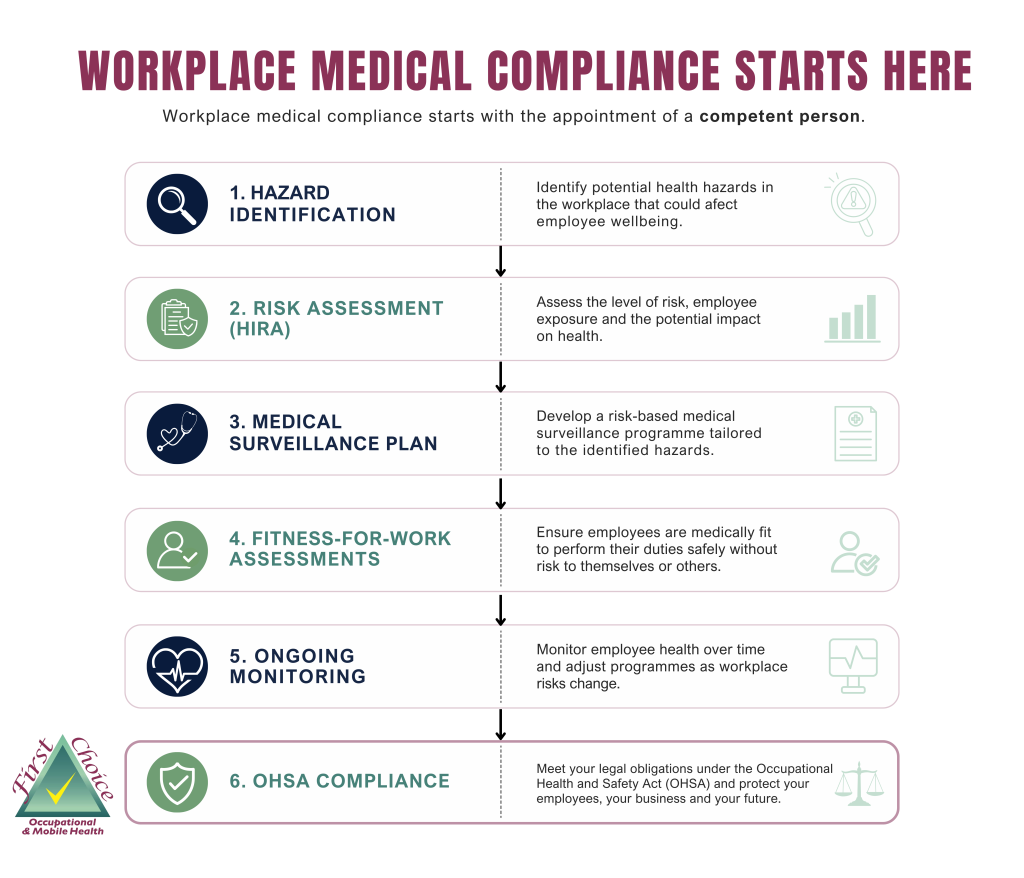
In reality, occupational health compliance starts with identifying workplace hazards and assessing the risks employees face while performing their duties. This process, often referred to as hazard identification and risk assessment (HIRA), helps determine what type of occupational health programme is required.
For example, a manufacturing business may implement hearing conservation monitoring for employees exposed to excessive noise, while employees working with respiratory hazards may require lung function testing. The specific medical surveillance programme should always be driven by the risks identified within the workplace.
An office-based employees’ exposure differs to that of an employee exposed to chemicals, for example, the office worker will have a higher risk in developing carpal tunnel syndrome, whereas the chemical worker has a higher risk of end organ damage. This means the frequency, probability and consequence of the hazard will determine the intervals and type of screening and monitoring identified in the Risk Assessment and established in the Medical Surveillance Programme.
Without a proper risk assessment, employers may conduct unnecessary medical examinations, overlook important health risks, or fail to implement the surveillance measures required under OHSA.
Medical Surveillance Requirements Under OHSA
Medical surveillance involves the systematic monitoring of employee health where workplace hazards may affect their wellbeing.
Importantly, medical surveillance should be risk-based and linked to identified workplace hazards rather than applied as a generic programme to every employee.
Not every employee requires the same level of medical surveillance. The extent of monitoring should always be determined by the hazards identified in the workplace, the employee’s exposure level, and the nature of the work being performed.
The type of surveillance required should always be determined by workplace risk assessments, employee exposure levels, and the nature of the occupational hazards present.
By implementing appropriate surveillance programmes, employers can identify potential health concerns early and take corrective action before they develop into more serious occupational illnesses.
When Does OHSA Require Fitness-for-Work Assessments?
One of the most important components of occupational health compliance is ensuring that employees are medically fit to perform their duties safely.
A fitness-for-work medical assesses whether an employee can carry out specific job tasks without placing themselves or others at risk.
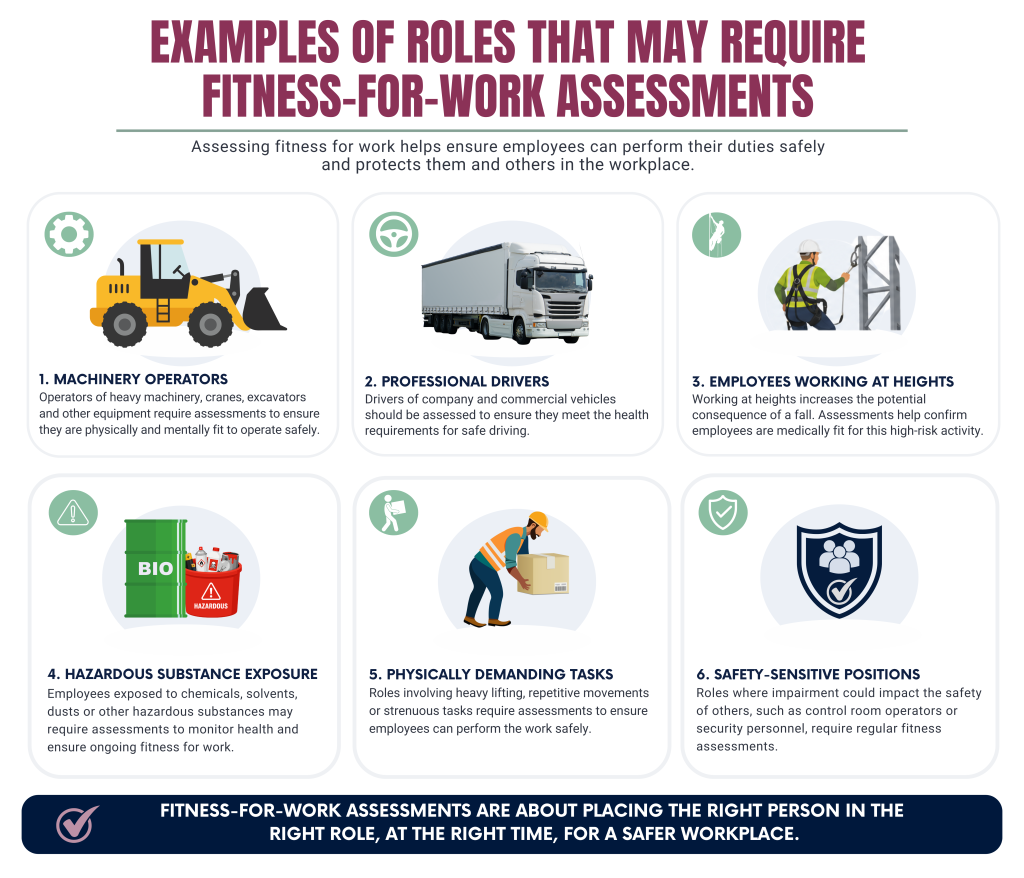
These assessments are particularly important where work involves:
- Operating machinery
- Working at heights
- Driving company vehicles
- Exposure to hazardous substances
- Physically demanding tasks
- Safety-sensitive positions
Consider a forklift operator working in a busy warehouse environment. If an underlying medical condition affects concentration, vision, or reaction time, both the employee and surrounding workers could be placed at risk. A fitness-for-work assessment helps identify these concerns before they contribute to an incident.
Similarly, an employee required to work at heights may need regular medical evaluations to ensure they remain medically fit to perform their duties safely.
A properly conducted fitness-for-work assessment helps employers make informed decisions while supporting both employee wellbeing and workplace safety.
Are Your Medical Providers Properly Qualified?
A common compliance risk occurs when employers use providers who are not appropriately qualified to conduct occupational health assessments.
Occupational medical examinations should be performed by healthcare professionals who operate within their authorised scope of practice and have the necessary occupational health expertise.
Using unqualified providers may result in:
- Invalid medical certificates
- Incomplete assessments
- Missed occupational health risks
- Regulatory non-compliance
- Increased legal exposure for employers
Employers should always verify that occupational health service providers have the appropriate qualifications, registrations, and experience required for workplace medical programmes. This can be verified online by accessing the SANC eRegister for Occupational Health Nursing Specialists and HPCSA iRegister for Occupational Medical Practitioners.
Choosing qualified occupational health professionals not only supports compliance but also helps ensure employees receive assessments that are relevant to the risks present in their work environment.
The Importance of Accurate Record Keeping
Medical surveillance records play a critical role in demonstrating compliance and protecting both employers and employees.
Proper record keeping helps employers:
- Track employee health trends
- Demonstrate compliance during inspections or audits
- Support compensation claims management
- Provide evidence of occupational health screenings and monitoring
- Maintain continuity of medical surveillance programmes
Confidentiality remains essential. Medical information must be securely stored and managed in accordance with applicable privacy and data protection requirements.
Poor record management can create significant compliance challenges, particularly if incidents, disputes, compensation claims, or regulatory investigations arise.
The Risks of Non-Compliance
Failing to manage workplace medical compliance correctly can have serious consequences.
Workplace Incidents and Injuries
Employees who are not medically fit for specific duties may face increased risks of accidents, injuries, or health complications.
Legal Liability
Employers may be held accountable if inadequate occupational health management contributes to workplace incidents or occupational illnesses.
Compensation Claims
Occupational injuries and diseases can result in costly compensation claims and increased administrative burdens.
Regulatory Action
Non-compliance with occupational health requirements may lead to inspections, enforcement measures, and reputational damage.
Business Disruption
Workplace incidents often result in lost productivity, operational delays, and increased costs.
Proactive compliance is almost always more cost-effective than dealing with the consequences of non-compliance.
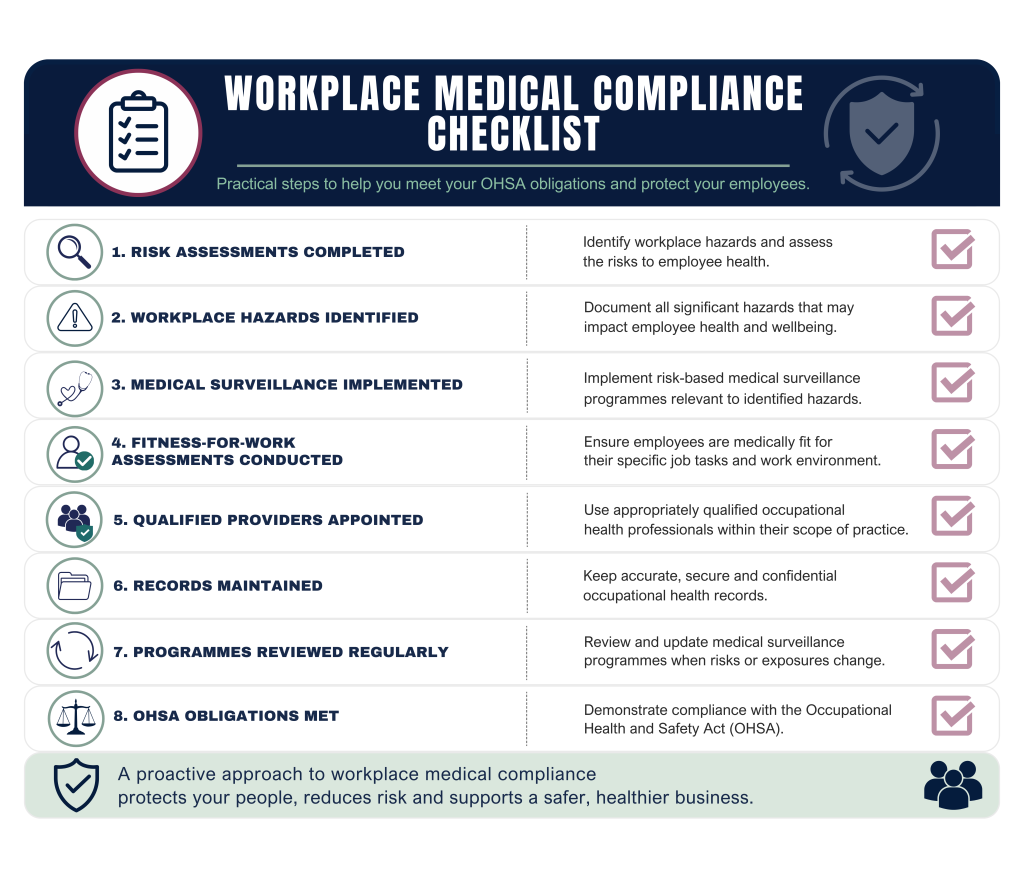
Best Practices for Employers
Maintaining workplace medical compliance does not need to be complicated. Employers can significantly reduce risk by following a few key principles:
Conduct Regular Risk Assessments
Identify workplace hazards and determine whether medical surveillance is required.
Use Qualified Occupational Health Providers
Work only with reputable occupational health professionals who understand legal and industry requirements.
Implement Risk-Based Medical Surveillance Programmes
Ensure surveillance activities align with actual workplace risks and employee exposures.
Keep Accurate Records
Maintain complete, secure, and up-to-date occupational health documentation.
Review Programmes Regularly
Workplace risks can change over time. Medical surveillance programmes should be reviewed and updated when necessary.
Educate Supervisors and Employees
Awareness helps ensure occupational health processes are understood and supported throughout the organisation.
Compliance Is More Than a Checkbox Exercise
Many businesses view workplace medicals as a compliance requirement to be completed and filed away. In reality, occupational health assessments are an important tool for protecting employees, reducing risk, and supporting safer workplaces.
A compliant medical surveillance programme helps employers identify concerns early, meet their legal obligations, and create a healthier working environment for everyone.
Ultimately, legally compliant workplace medicals are not about paperwork or passing an inspection. They are about ensuring that employees can perform their duties safely, occupational health risks are properly managed, and businesses fulfil their obligations under OHSA.
If you are unsure whether your current workplace medical programme meets legal and occupational health requirements, now is the ideal time to review your processes and ensure your business remains compliant.
Need Assistance with Occupational Health Compliance?
First Choice Occupational and Mobile Health helps businesses implement effective workplace medical programmes, medical surveillance systems, and fitness-for-work assessments tailored to their operational requirements.
Contact our team today to ensure your workplace medicals are compliant, professional, and aligned with occupational health best practices.