When an employee’s health becomes a workplace concern
An employee returns to work after several weeks of medical absence. He is ready to resume his duties, but his job involves heavy lifting and operating machinery. His manager is concerned about safety, while HR needs to establish whether the employee can return to his normal duties or requires temporary adjustments.
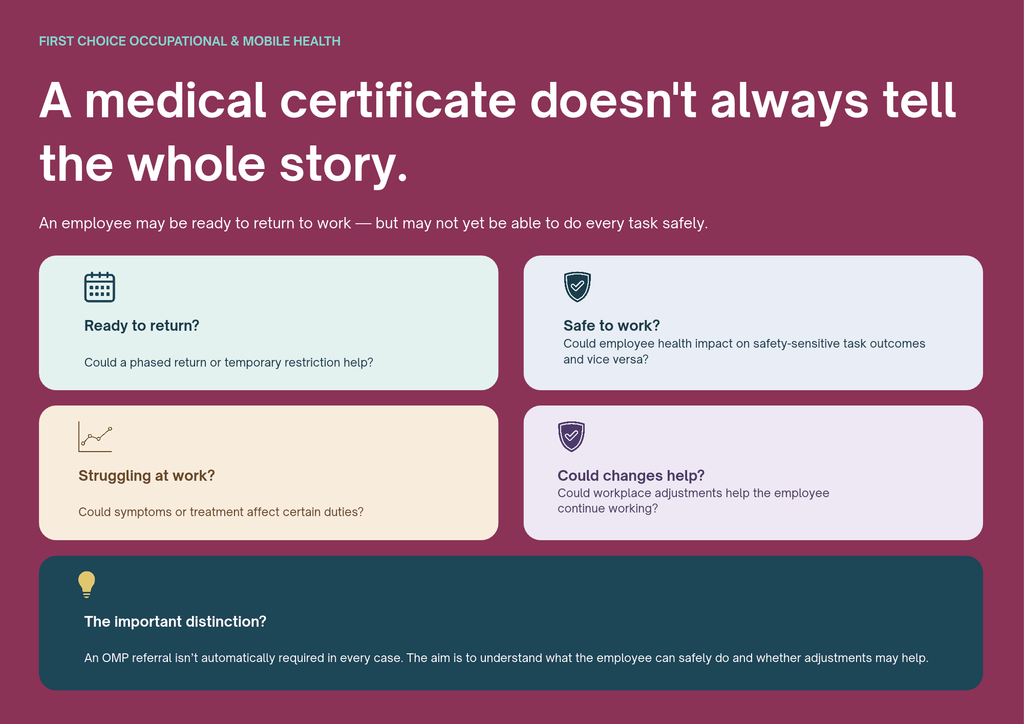
A medical certificate may explain the absence, but does it establish whether the employee can safely perform every aspect of their job?
This is where an Occupational Medical Practitioner (OMP) may be able to help.
An OMP assesses an employee’s health in relation to their work, helping to identify functional limitations, relevant restrictions and possible adjustments. This information can support decisions about fitness for work, rehabilitation, reasonable accommodation and return-to-work planning.
For South African employers, however, the issue goes beyond obtaining a medical opinion. Employers may have legal duties relating to workplace safety, fair incapacity management, disability discrimination and the protection of confidential medical information.
Understanding when an OMP referral is appropriate—and what must happen afterwards—helps employers make informed decisions while treating employees fairly.
When should you refer an employee to an OMP?
There are no universal number of sick-leave days or medical certificates that automatically requires an OMP referral. The decision depends on the employee’s circumstances, the demands of the job, potential safety risks and any applicable legal requirements.
An assessment may be appropriate in the following situations.
1. Prolonged or recurring sick leave
An employee may be absent for an extended period following surgery, injury or serious illness. Repeated absences may also raise questions about their ability to perform their duties consistently.
An OMP can help clarify the employee’s current work capacity, identify relevant restrictions and advise on possible return-to-work arrangements.
Repeated sick leave should not automatically be treated as misconduct or evidence of incapacity. The employer should establish the facts and consider whether further medical information is reasonably necessary.
2. Returning to work after illness or injury
An employee may have recovered sufficiently to return to work but remain unable to perform all their normal duties.
For example, someone recovering from back surgery may be able to work but still need to avoid heavy lifting. An OMP can assess the demands of the position and advise on appropriate restrictions or a phased return.
The aim is to support a safe, sustainable return to work rather than unnecessarily delay the employee’s return.
3. Concerns about workplace safety
Where an employee performs safety-sensitive work, a health condition or treatment may affect their ability to perform certain duties safely.
Examples include operating machinery, driving, working at heights or handling hazardous substances.
The employer should consider the actual duties and risks rather than making assumptions based on a diagnosis alone. An OMP may help determine whether restrictions or other protective measures are appropriate.
Certain workplaces also have specific medical surveillance or examination requirements under occupational health and safety legislation. Where these apply, the employer must comply with the relevant requirements.
4. A medical condition affecting work performance
Pain, fatigue, reduced mobility or treatment side effects may affect an employee’s ability to perform particular tasks.
Where there is a reasonable basis to believe that a health issue may be affecting work capacity, an OMP assessment can help clarify the employee’s functional limitations and identify practical solutions.
For example, adjusting a workstation or temporarily modifying duties may enable an employee to continue working productively.
5. A possible disability requiring reasonable accommodation
A disability does not automatically mean that an employee cannot perform their job.
An OMP may help identify the employee’s abilities, relevant restrictions and medically appropriate adjustments. These could include adapted equipment, changes to working arrangements, modified duties or assistive technology.
The employer must then consider the findings alongside its obligations under the Employment Equity Act and the applicable Code of Good Practice on the Employment of Persons with Disabilities.
Is a referral always legally required?
No. An OMP referral is not automatically required whenever an employee becomes ill, takes extended sick leave or has a disability.
It is important to distinguish between a medical assessment specifically required by applicable legislation, an assessment that helps an employer manage a genuine safety concern, and one that provides evidence for a fair incapacity or accommodation process.
The employer should identify which situation applies rather than treating every referral as a statutory requirement.
What does South African law require of the employer?
The legislation provides the framework for managing these situations. The practical question is what the employer must do, and how an OMP can help.
1. Protect employees’ health and safety
The Occupational Health and Safety Act 85 of 1993 (OHSA) places a general duty on employers, as far as reasonably practicable, to provide and maintain a working environment that is safe and without risk to employees’ health. Section 8 is particularly relevant.
Where an employee’s health may affect their ability to perform hazardous or safety-sensitive duties, the employer should assess the relevant risks and consider appropriate protective measures.
Depending on the workplace and applicable regulations, medical surveillance or examinations may be specifically required. These requirements are not universal, so employers must establish which provisions apply to their operations.
An OMP can assist with occupational medical advice, but the employer remains responsible for managing workplace risks and implementing appropriate measures.
2. Manage incapacity fairly and consider reasonable accommodation
Two important laws apply here: the Labour Relations Act 66 of 1995 (LRA) and the Employment Equity Act 55 of 1998 (EEA).
The LRA and the applicable Code of Good Practice: Dismissal provide the framework for dealing with incapacity due to ill health or injury. Where an employee’s ability to perform their work is in question, the employer must follow the applicable fair process.
This involves understanding the nature and extent of the incapacity, consulting with the employee and considering relevant alternatives. Depending on the circumstances, these may include adapting duties or working conditions, allowing further recovery time or considering suitable alternative work.
The EEA prohibits unfair discrimination on grounds including disability, subject to its provisions and applicable exceptions. The applicable Code of Good Practice on the Employment of Persons with Disabilities provides further guidance on disability and reasonable accommodation.
Where disability is involved, the employer should consider the employee’s abilities, the essential functions of the job and whether reasonable adjustments could enable them to work.
An OMP’s report may provide valuable evidence about functional capacity and medically appropriate restrictions. It does not, by itself, justify dismissal or replace the employer’s obligation to consider reasonable accommodation and follow a fair process.
If dismissal is ultimately contemplated, the employer must comply with the applicable legal requirements and be able to demonstrate that relevant alternatives were genuinely considered.
3. Handle sick leave and medical information correctly
The Basic Conditions of Employment Act 75 of 1997 (BCEA) regulates statutory sick-leave entitlements and medical certificates in specified circumstances.
Under section 23, an employer may generally require a medical certificate for paid sick leave where an employee is absent for more than two consecutive days or on more than two occasions during an eight-week period, subject to the section’s requirements.
These rules concern medical certificates for sick leave. They do not automatically require an OMP assessment.
Separately, the Protection of Personal Information Act 4 of 2013 (POPIA) regulates the processing of personal information, including health information, subject to its provisions and applicable exceptions.
Employers should ensure that medical information is handled for a legitimate purpose, that the applicable lawful basis for processing and disclosure is established, and that appropriate confidentiality and security safeguards are in place.
In practice, the OMP needs relevant information about the employee’s duties and workplace risks. The employer generally needs the work-related findings, restrictions and accommodation recommendations—not unrestricted access to the employee’s entire medical history.
Where an injury or disease may be work-related, the Compensation for Occupational Injuries and Diseases Act (COIDA) may also apply. The employer should follow the relevant reporting and claims procedures.
How to make an effective OMP referral
Once you’ve decided that an OMP assessment is appropriate, the quality of the referral matters. The more clearly the OMP understands the employee’s job and the concern, the more useful the advice is likely to be.
Include the employee’s job description, the duties they perform, any relevant workplace risks and the reason for the referral. Then ask specific questions about their ability to perform those duties, any restrictions that may be needed and whether adjustments could help.
For example, rather than simply asking, “Is this employee fit for work?”, ask, “Can this employee safely perform their usual duties, including heavy lifting, and are any temporary restrictions recommended?”
Explain the referral to the employee, clarify how the assessment results will be used, and ensure medical information is handled appropriately.
The aim is to get practical, work-related advice that helps you decide what happens next — not simply a label of “fit” or “unfit”.
What happens if the employee cannot perform their normal duties?
An OMP’s report may recommend restrictions, a phased return to work or that the employee is not yet able to resume their duties.
The next step is to work out what this means for the employee’s role. Can they continue with some duties while recovering? Would a temporary change help? Or is a more formal incapacity process needed?
The answer will depend on the employee’s circumstances and the available options. If the employee may be unable to fulfil the requirements of their position, the employer should discuss the situation with them and follow the applicable fair process before making a decision about their employment.
A quick OMP referral checklist
Before proceeding, HR or the responsible manager should confirm:
- The reason for referral is documented.
- Any applicable statutory assessment requirements have been identified.
- The employee has been consulted where appropriate.
- The OMP has the relevant job description and risk information.
- The referral contains clear, work-related questions.
- Confidentiality and lawful information-sharing arrangements have been addressed.
- A process is in place to review the report, consider accommodation and agree on next steps.
Make informed, fair workplace decisions with First Choice
When an employee’s health affects their work, knowing what to do next isn’t always straightforward. An Occupational Medical Practitioner can help clarify what the employee can safely do, whether restrictions may be needed and what adjustments could support their return to work.
With the right medical guidance, employers can make more informed decisions, manage workplace risks and approach ill-health and disability matters with greater confidence — while treating employees fairly.
First Choice Occupational & Mobile Health can assist your organisation with occupational medical assessments and workplace health needs.
If you need guidance on an OMP referral, a fitness-for-work assessment or managing an employee’s return to work, contact First Choice Occupational & Mobile Health to discuss how we can support your workplace.
Disclaimer: This article provides general information about South African employment and occupational health practices and is not legal or medical advice. The applicable requirements depend on the circumstances, the work performed and the legislation and regulations in force.