
An Employee Leaves. But Does Their Occupational Health Record?
An employee’s last day at work may bring their employment to an end, but it does not necessarily bring the employer’s responsibility for their occupational health records to an end.
The Occupational Health and Safety regulations require employers to keep certain records relating to workplace assessments, air monitoring and medical surveillance. Depending on the workplace exposure and the regulation that applies, those records may need to be retained for decades.
For employers, the important questions are straightforward: What records must be kept? Who can access personal medical information? How long must the records be retained? And when does that period begin?
What Records Must an Employer Keep?
The exact records depend on the workplace exposure and the regulations that apply.
The Regulations for Hazardous Chemical Agents, 2021, for example, require employers to keep records of the results of required assessments, air monitoring and medical surveillance reports. The same regulation provides that personal medical records may be made available only to an occupational health practitioner.
Under the Asbestos Abatement Regulations, 2020, as amended, employers must keep records including asbestos inventories, asbestos risk assessments, air-monitoring results, medical surveillance reports, disposal certificates and clearance certificates.
The Lead Regulations, 2001 (Government Notice R236 of 28 February 2002) similarly require employers to keep records of assessments, air monitoring and medical surveillance.
Other occupational health regulations prescribe specific recordkeeping requirements for particular workplace exposures. These include:
- Physical Agents Regulations, 2025 (Government Notice 5952, promulgated 6 March 2025) – specified records including medical screening and medical surveillance reports.
- Noise Exposure Regulations, 2025 (Government Notice 5953, promulgated 6 March 2025) – specified records including medical screening and medical surveillance records.
- Ergonomics Regulations, 2019 (Government Notice R1589, published 6 December 2019) – specified records relating to ergonomic risk assessment and medical surveillance.
The key point is that employers need to identify which records are required for the hazards and exposures present in their workplace, and ensure that those records are retained in accordance with the applicable requirements.
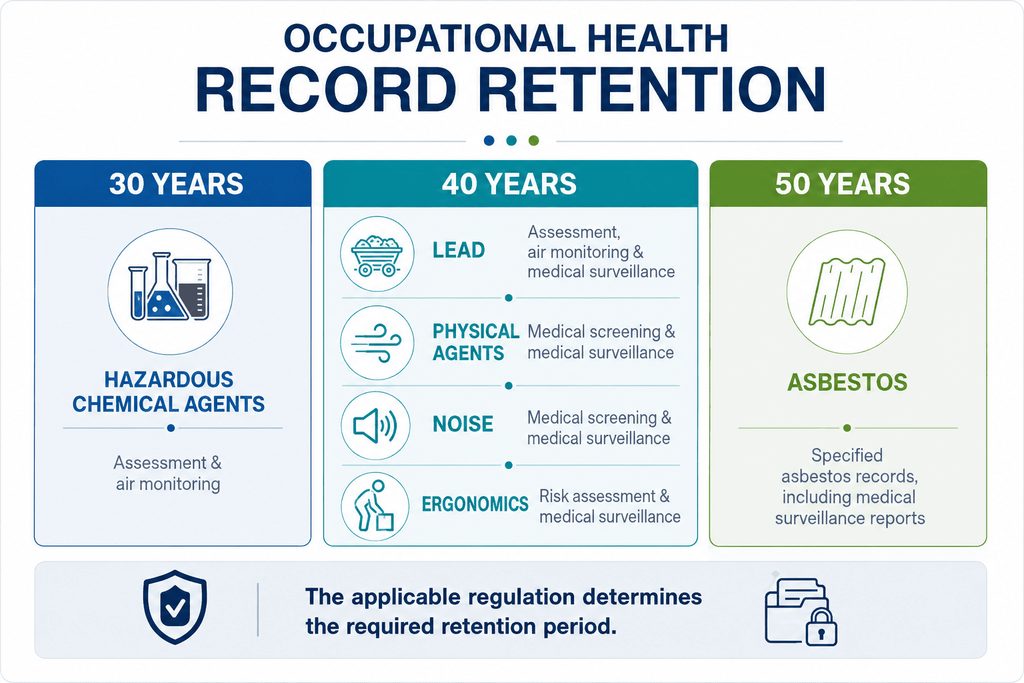
How Long Must Occupational Health Records Be Kept?
There is no single retention period that applies to every occupational health record.
Different regulations prescribe different minimum periods, depending on the exposure and the records concerned.
| Applicable regulation | Examples of records | Minimum retention period |
| Regulations for Hazardous Chemical Agents, 2021 | Assessment and air-monitoring records | 30 years |
| Physical Agents Regulations, 2025 | Medical Screening and Medical Surveillance Records | 40 years |
| Noise Exposure Regulations, 2025 | Medical Screening and Medical Surveillance Records | 40 years |
| Ergonomic Regulations, 2019 | Medical Screening and Medical Surveillance Records | 40 years |
| Lead Regulations, 2001 | Assessment, air-monitoring and medical surveillance records | 40 years |
| Asbestos Abatement Regulations, 2020, as amended | Specified asbestos-related records, including medical surveillance reports | 50 years |
These periods are not choices for an employer. The applicable regulation determines what records must be retained and for how long.
This is why employers should identify the requirements that apply to their particular workplace rather than applying one general retention period to every occupational health record.
Personal Medical Records Are Different
Keeping the required records does not mean that everyone in the organisation can access the personal medical information contained in them.
The Regulations for Hazardous Chemical Agents, 2021 specifically provide that personal medical records may be made available only to an occupational health practitioner. The regulations separately provide for access to other records by inspectors and, in specified circumstances, relevant health and safety representatives or health and safety committees.
Other occupational health regulations also set out specific requirements for accessing medical screening and medical surveillance records.
Under the Physical Agents Regulations, 2025, Noise Exposure Regulations, 2025, and Ergonomics Regulations, 2019, specified medical screening and medical surveillance records may be made available to a person subject to the formal written consent of the employee. These regulations also distinguish between access to medical records and access to other occupational health and safety records.
Access to occupational health records therefore depends on the requirements of the regulation that applies to the workplace exposure. These requirements may cover what records must be kept, how long they must be retained and who may access them.
For employers, the principle is straightforward:
Keep the required records for the prescribed period, protect personal medical information, and follow the access requirements set out in the applicable regulation.
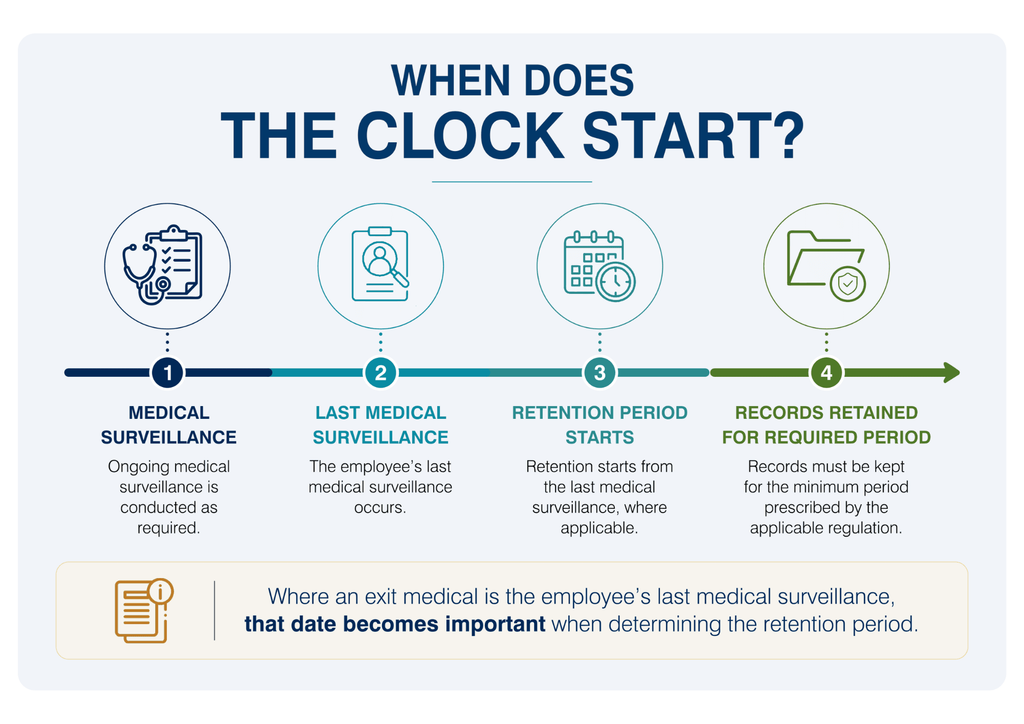
When Does the Retention Period Start?
Knowing how long a record must be kept is only part of the requirement. Employers also need to know from which date the retention period is calculated.
This is where the specific legal requirement becomes important.
For example, the Mine Health and Safety Act expressly provides that medical surveillance records must be safely stored and not destroyed for 40 years from the last date of the employee’s medical surveillance. It also provides for an exit medical examination when the employment of an employee who was subject to, or required to be subject to, medical surveillance is terminated.
This illustrates why the employee’s last medical surveillance can be an important date when calculating a retention period.
Where an exit medical or exit medical screening is required and is the employee’s last medical surveillance, that date becomes particularly important.
The key point is to establish which requirement applies to the employee and what date is relevant to the retention period.
Why the Exit Medical Can Matter
An exit medical is not simply another appointment to add to an employee’s final days at work. Where the applicable regulation requires an exit medical or health examination, it forms part of the occupational health requirements that apply to the employee.
Two examples under the Occupational Health and Safety Act are the Noise Exposure Regulations, 2025 and the Ergonomics Regulations, 2019.
- The Noise Exposure Regulations, 2025 require an employer to ensure that an exit medical screening is carried out by an occupational health practitioner on termination of employment. A medical screening conducted within six months before termination is deemed to have fulfilled the exit medical screening requirement.
- The Ergonomics Regulations, 2019 require medical surveillance to include an exit health examination informed by the ergonomic risk assessment.
For employers, this means it is important to establish:
- Whether medical surveillance is required for the employee.
- Whether an exit medical, medical screening or health examination is required.
- What the applicable regulation requires for that employee’s exposure.
- Which date is relevant when calculating the applicable record-retention period.
The requirements are not identical across all occupational health regulations, so employers should identify the regulation applicable to the workplace exposure and follow its specific medical surveillance and exit examination requirements.
What Employers Should Take Away
The practical responsibility can be reduced to four points:
Know what to keep.
Identify the assessments, air-monitoring results, medical surveillance reports and other records required for the workplace.
Know how long to keep it.
Retention periods can differ. Depending on the regulation and record concerned, the period can be 30, 40 or 50 years.
Protect personal medical information.
Personal medical records are subject to specific access requirements, including access by an occupational health practitioner under the regulations discussed above.
Know when the retention period starts.
Where the applicable requirement links the period to the employee’s last medical surveillance, that date needs to be accurately established.
The Bottom Line
An employee may leave your business, but their occupational health records may still need to be retained for many years.
Employers therefore need to identify the records required for their workplace, understand the applicable retention period, protect personal medical information and establish the relevant date for calculating that period.
It is therefore best practice to:
- Identify a responsible person for the safekeeping of occupational health records.
- Establish a documented system for the safe storage and safekeeping of these records.
- Legally appoint the person responsible for the safekeeping of the records.
The employee may leave. The record may not.
Need Assistance With Occupational Health Medical Surveillance?
First Choice Occupational & Mobile Health can assist employers with occupational health medical surveillance programmes based on workplace risk profiles and applicable legislative requirements.
Contact First Choice Occupational & Mobile Health to discuss your workplace occupational health requirements.